Hidden like Viking gold under the landscape there is a rich body of nearly lost folkwitch tradition hiding in plain sight on the internet. Particularly in the 18th and 19th century antiquarians, folklorists and ethnologists documented the rural and occasionally urban folk beliefs of practically all of the UK and much of Europe. Organizations like the Folklore Society, founded in 1878, were created to help catalog and publish this body of collected ethnological data. A vast repository of a spectrum of witch and cunning craft practices.
Below are a list of links to various sources on the internet. The non Abramhamic roots of British folk traditions date from an era of Celtic settlers, and thus much of the spirit tradition concerns beings we now collectively call “fairies”, though their origins and nature differ greatly.
Books Available Online for free:
Folklore Society/Folk-Lore Journal:
Over 100 publications made by the Folk-Lore Society can be found on Archive.org. Unfortunately these are mostly unsorted, although they represent a massive amount of folkwitch information. Particularly in the realm of curses, hexes, salves, second sight, and boundary magic.
I will be launching a separate blog dedicated to delving into the contents of the Folklore Society’s publications in the next few weeks. In the meantime – Happy digging: Link to archive of FOLKLORE JOURNAL
Books whose content focuses on first-hand accounts of folk traditions, alpha by author. (* denotes particularly important titles)
Benjamin Thorpe
-Northern Mythology, Comprising the Principal Popular Traditions and Superstitions of Scandinavia, North Germany, and the Netherlands Volume 1 Volume 2 Volume 3
Lady Wilde
– Ancient Legends, Mystic Charms, and Superstitions of Ireland * Volume 1 Volume 2 Volume 3
With permission from lettherebedoodles I decided to take their amazing Racebent Disney Princess Seriesand, rather than just seeing them as different versions of the original characters, give them stories and fairy tales of their own. I plan on doing her entire series- hopefully I won’t disappoint!
Some of the stories will be based on the culture the new heroine is based on, and others will be stories from other cultures (such as ‘traditional’ western fairy tales), even real life people will inspire these Disney-style Princesses and Heroines. But please remember- this is all for fun. I’m not pretending to be an expert on any of this. I’ll try my best to do right by these characters and cultures, and if there is something horribly offensive, please let me know how I can fix it.
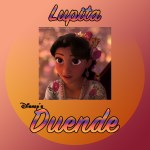
Lupita is the oldest child in her family, with two younger siblings, fraternal twins Felipe and Josefina. Lupita loves to paint, but after the death of her mother almost a year ago, she’s been very depressed. All she’s had time for is hard work and chores and keeping the household running. Her art has suffered, and she’s frustrated with life, and that the twins seem to only goof off and get into trouble.
One night, just before Dia de los Muertos is about to start, Lupita loses her cool and tells the twins to do something, anything, to help out around the house. Laughing, they run off into the darkness, Lupita chasing angrily after- only to watch them be snatched up by La Llorona.
As Dia de los Muertos begins, Lupita receives a visit from her mother, who tells her that she must save the twins before Dia de los Muertos ends and the spirits of the dead return to the afterlife. So Lupita sets out to find La Llorona, and in the process, find joy and laughter in her own life again.
Yara – Flow
Yara has always loved the river, just like the sirens she was named for when she was found orphaned as a baby. And her home, a floating village on the Amazon River, gave her plenty of reasons to be near the water. Even though the river could be dangerous, Yara was never afraid.
So when a group of wealthy explorers come, wanting to map the river and document wildlife, she happily agrees to be their guide. But these men are not what they seem, and when they commit an unthinkable crime- killing a river dolphin- the river begins to flood like never before. The villagers then tell her the truth about her origins. Yara isn’t just her name, she is truly an Iara, a mermaid of the Amazon. With help from a charming and handsome shape-shifter, Boto, she sets out to find a way to stop the flood from destroying her home.
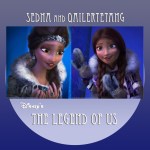
Sedna and Qailertetang – The Legend of Us
Sedna is considered the most beautiful woman in the world. Qailertetang is her best friend… and thinks she may be falling in love with Sedna. But Qailertetang is too afraid to say anything, and then a strange man shows up at their village. He reveals himself to be a powerful spirit, who can take the form of a massive Petrel and control the weather. The Petrel spirit demands that Sedna marry him, and when she refuses, he kidnaps her and takes her to a distant sea cliff.
Heartbroken and desperate to save her friend, Qailertetang, sets off in a kayak to save her. Along the way, she saves a two-spirit shaman, and they tell her that even though love is confusing, she should tell Sedna how she feels. Meanwhile Sedna, trapped on a sea cliff, plots a way to escape on her own. Together, they find a way to defeat the Petrel spirit.
Together, they change in a way they would have never thought possible.
Author’s Note: Loosely based on what I’ve been able to find about the Inuit goddesses/spirits of Sedna and Qailertetang. I don’t think I’ve made any horrible errors here, and I wish I knew more about Inuit naming conventions to come up with a diminutive version of Qailertetang because that is a mouthful. But for the sake of not accidentally shortening it to something offensive, I left it as is.
P.S. Friendly reminder if you have any, LITERALLY ANY, resources on African (specifically Luo/West Niletic/East African- think the Jasmine edit) stories, folktales, even modern fiction, please let me know. I’m having a lot of trouble with it.
do you ever sit and think about your female ancestors and like how many of them endured forced marriages, sexual abuse, physical violence and complete deprivation of education and autonomy and suffered silently for literally centuries. going through pregnancies and child birth without modern medicine, having multiple children and watching most of them die before the age of five because that was just the way of life back then? and ultimately you are a product of their pain? i think about them a lot and then i think about how many women continue to share their reality in this current year
We were talking to my father-in-law about family history once and he told us a story about how his grandmother (IIRC) hadn’t had a year of birth put on her gravestone “because she was only fourteen when she had her first kid!” like it was a funny and slightly naughty story.
Cue me, my wife, and my mother-in-law all staring at him like Jesus Christ, dude, think that through.
Had I been born, say, 70 years earlier, I would have been married off to some man I’d have met maybe two or three times before marriage and who would have been chosen for me on grounds of ‘how can we get potential rights to that farm if all men of that family die’. Apparently this would have been more of an arranged marriage than a forced marriage but I wonder how many women got their will when they said ‘I don’t want to marry him’ or how many even knew that you could say no.
My great grandmother died giving birth to my grandmother. My great-great grandmother, just when she thought she was done raising kids, had to become a mother all over again to raise my grandmother. My mom had birth complications with my older sister, and probably would have died were it not for modern medicine, meaning I wouldn’t even be here at all. The women in my family have literally risked or lost their lives for their children. And then we take our fathers’ last names. Sometimes I want to change my surname to Tinker or Kelly to honor my strong female ancestors.






 ImagineCreateDevour