[”I want to see my little boiii…” “Here he comes!” “…I want to see my little boiii!”]
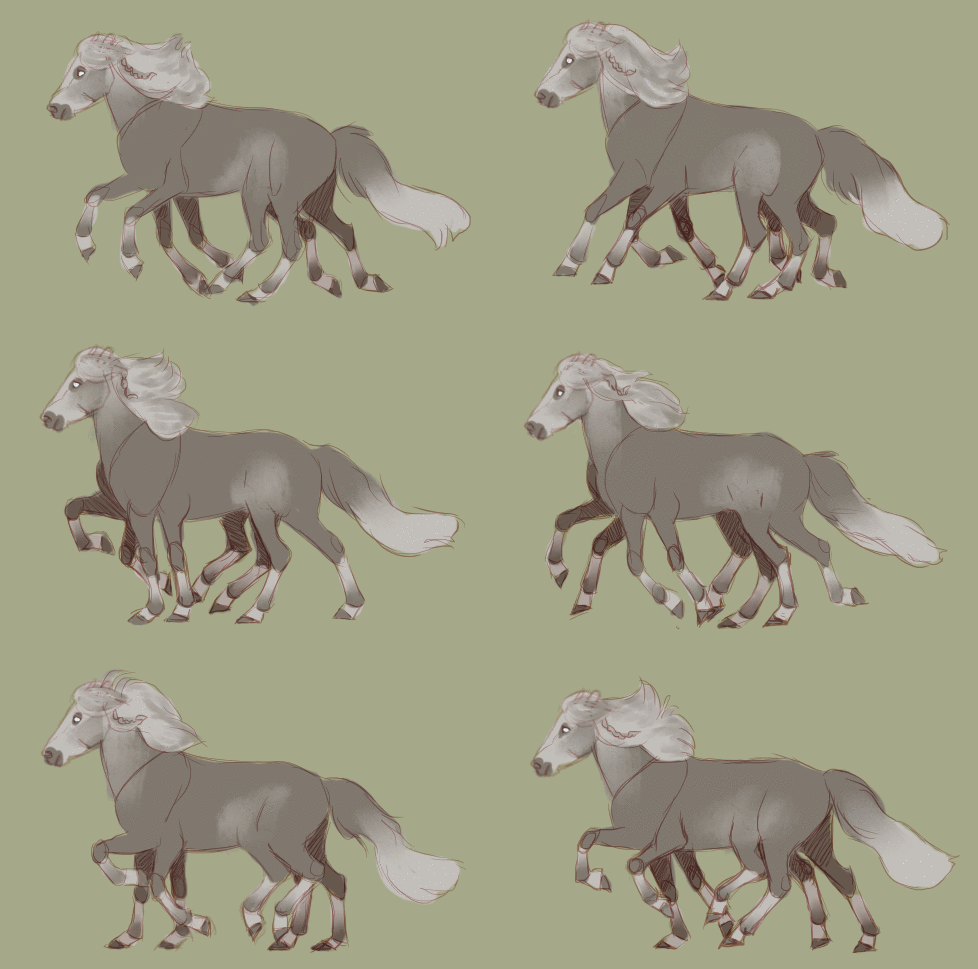
Sleipnir run cycle. It could be smoother, and if I get another boost of energy (because animation really requires that extra inspiration and spite) I might even shade it more thoroughly. But it’s good enough for now, and the front legs work nicely!
It must have been a pain to learn to run with that many feet. Foals are usually clumsy enough with just four.
“Grey horse” was an omen and a metaphor for death from viking age poetry to medieval ballads in the Nordic countries. Snorri specifically mentions that Sleipnir is grey, and his ability to visit Hel and take a rider there and back unharmed seems to link Sleipnir closely to death.
Hatshepsut: the Unforgotten Princess (1508-1458 BCE)
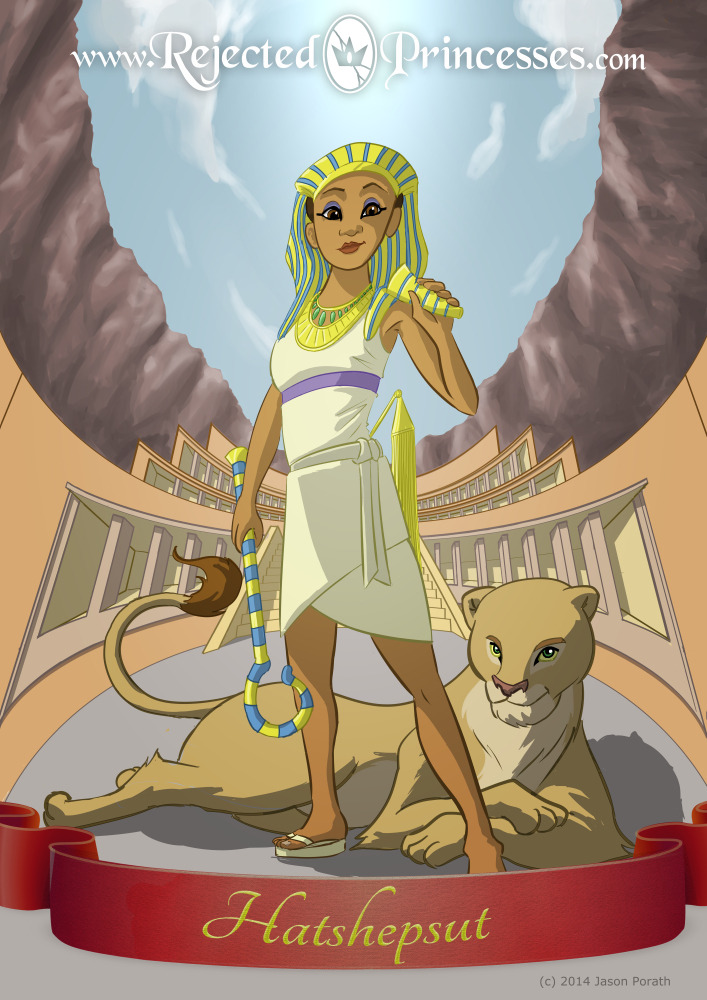
This Rejected Princess definitely falls under “too awesome”: Hatshepsut, arguably the greatest pharaoh in history. Forget Cleopatra, King Tut, or Nefertiti – Hatshepsut was the jam.
You’d be forgiven for not knowing about her, though. Thanks to a sustained campaign by her successors to erase all traces of her reign, it was not until fairly recently that she came back to historical prominence. She was re-discovered due to the fact that her time in power saw such an incredible proliferation of architecture, statues, and art that it proved impossible to scrub mention of her from *everything*. So much of her work has survived to present day that almost every major museum in the world has at least one piece from her. The New York Metropolitan Museum of Art has an entire room devoted to her.
All this, despite the fact that she ruled for less than twenty-two years, fifteen hundred years before the birth of Jesus.
In fact, speaking of Jesus – you know the myrrh that the wise men brought to his birth? Almost certainly due to Hatshepsut importing it 1500 years earlier, in the first recorded attempt to transplant foreign trees.
Moreover, she did her own PR. In order to solidify her claim to the throne, she spread word that her parents were told by the gods that she was to be pharaoh. The official story was that, at the gods’ behest, her mother gave birth to her in a LION’S DEN. To quiet the gossip at court, she began her rule wearing men’s clothing, including the pharaoh’s false beard. Once they stopped flapping their gums, she went back to wearing whatever the hell she wanted.
Art notes:
She’s got the pharaoh’s beard, flail, and crook – with the flail tucked away, since she was more a shepherd than a slavedriver.
I forgot the uraeus (serpent) on the headband though! Major oversight!
She is standing in front of The Temple of Hatshepsut, an actual temple that survives to this day.
The lion around her leg is a callback to her aforementioned PR campaign.
The angle of the drawing is super-distorted, I know. I may go back and fix it at some point. I was trying something new, the idea being that the world bends to her.
(thanks to Jenifer Castellucci and Amanda Klimek for help with corrections on this!)
Next Rejected Princess for you all: Pasiphaë, mythological Greek queen.
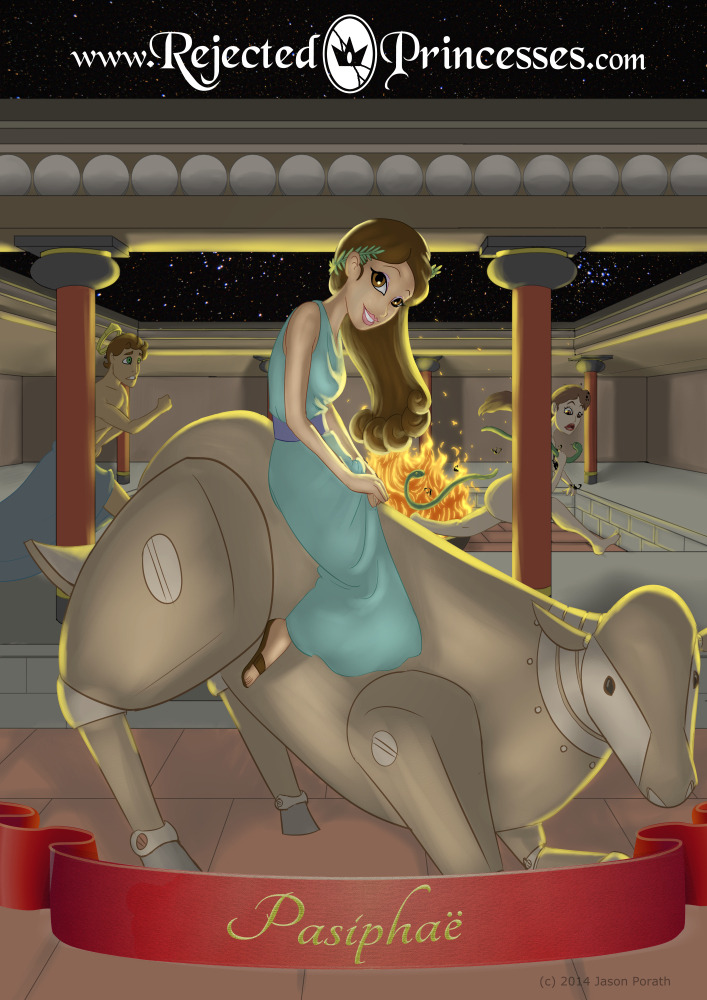
Pasiphaë is best known for two things. The first, and better known of the two, was that she had an insatiable need to have sex with a bull. Not just any bull, but a bull that Poseidon gave her husband, king Minos. So the legend goes, her husband was supposed to sacrifice the bull back to Poseidon, but decided to keep it. In response, Poseidon was like, “Hey Pasiphaë, you know what’d be real good right now? Bull penis.” So she had the court inventor, Daedalus, build her a hollowed-out wooden cow so that she could have sex with the bull.
She later gave birth to the Minotaur. Daedalus got busy building a labyrinth.
The second thing she was well-known for was ruining her husband’s sex life. Being a powerful sorceress (her sister was Circe) and knowing that her husband was cheating on her, she made a charm such that if he slept with anyone save her, he would ejaculate serpents, scorpions, and millipedes. Gross.
Now, here’s where it gets weird. Her husband’s mother, Europa (after whom Europe itself is named), had almost the exact same story. In her story, Zeus took the form of a beautiful bull, approached her, carried her out to an island in the ocean, and mated with her. She then had three kids, one of whom was king Minos – Pasiphaë’s husband. Notably Europa’s tale didn’t have the whole arachnid-semen part of the story.
So what’s the deal? As best as historians are able to determine, they were the same legend. Europa was the Minoan version, and Pasiphaë the Greek one. When the Greeks rolled through and conquered Crete, they essentially rewrote things. Instead of her being a powerful and in-charge woman, she was a depraved and lustful pawn. Their way of breaking Minoan traditions and bending it to their own ends. Dick move, guys.
Artistic notes:
Her laurel garland makes two horns (she was often depicted with a horned crown, being a bull goddess).
The night sky in the background is the Taurus constellation, naturally.
The setting is a direct copy of king Minos’s palace at Knossos (which really exists).
The cow is modeled after a native breed local to that region called the Greek shorthair.
The only severe inaccuracy I’m aware of is that the cow was supposed to be on wheels – probably a reference to an actual statue that the ancient Minoans used. I liked it better with hooves though.
Oh, and the lady in the background is wiping scorpions off her chest and there are some in her hair. Make of that what you will.
EDITS: an earlier version of this post referred to ancient Crete as Minoa – how embarrassing! Thanks to bachvevo for the correction!
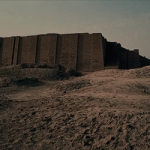
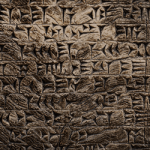
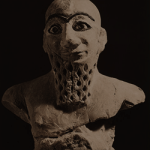
Sumerian was a language isolate spoken in ancient Sumer in what is now southern Iraq, first attested to around 3000 BCE. After the Sumerian city states were conquered by the Akkadians, it was largely replaced by the Semitic language Akkadian, but continued to be used as a liturgical and classical language until the time of the Assyrians. Sumerian became extinct around 1700 BCE, but is known because of the great deal of texts and engravings that have survived.
en-lil lugal kur-kur-ra ab-ba dingir-dingir-re-ne-ke inim gi-na-ni-ta dnin-ĝir-su dšara-bi ki e-ne-sur. [Inspired by @elnas-studies]





 ImagineCreateDevour