Ahhhh I guess that’s a very general way of putting things, if you take it at face value. Just keep in mind that Set is not going to be the most open or forthcoming character, if you ask him about his own relationships. There are some that he is very open about, yes, but others… not so much – he’ll show you what he wants you to see, basically (or as much as I’ll let him show without outright posting spoilers ᕕ( ᐛ )ᕗ)
Having said that, his relationship with his parents is an interesting thought to chew on. Let’s just says it’s… stable. Not the closest parent-child relationships in the world, but not as bad as you might expect.
Believe it or not, Set actually respects his parents – something that was of high importance in Ancient Egyptian culture, even for rebellious children like Set was. But it’s a very subdued respect on his part, especially because he doesn’t even see them that often (not physically, anyway). And the ways he interacts with them differ a lot, because his parents are very different deities. The details get a bit long, so I’ll place it under the readmore /o/
Sometime ago someone asked me if I’d like to talk about what it’s like to be Brazilian and a Hellenic polytheist. Well, I used to think that being Brazilian didn’t change much my religion, but today I see I was wrong. I have said before about my difficulty to see the sea as the kingdom of Poseidon, since in Brazil Yemaya is a very popular orixá, she’s always referred to as “Yemaya, the queen of the sea”.
As much as I’m a hellenic polytheist, I also live in a country of big religious diversity. So, I don’t share the same beliefs of the Ancient Greeks when it comes to the afterlife. Well, actually I do, but I interpret it differently. Brazil is a country full of all kinds of diversities that are able to talk to each other, so I don’t believe in A Place For All The Dead. Mythology, for me, does not talk about The Truth, mostly because I don’t believe it exists, but about The Truths. And I don’t believe we are bond forever to the Afterlife Place of our religion.
For example, the ideas of greatness have changed. Nowadays there are no more heroes like in Ancient Greece. For me, that does not mean that to enter in the Islands of the Blessed you have to kill a great monster or win a huge war. Acts of bravery in our times are different. We no longer live in Ancient Greece and can’t and shouldn’t pretend to be ancient Greeks. I am Brazilian.
Another example, I agree with the ancient Greeks that after death the dead have no longer the fire that the we the living have. But I really don’t believe it’s not life anymore. What I believe is that our existence in the afterlife can be seen as numb and lifeless when we compare it to the mundane life. Some of us still will crave mundane delights like wine, milk, honey and bread.
I believe It’s just… different. We no longer are able to see and feel Helios’ divine light, we’re no longer in Gaia’ earthly divine body.
I personally believe we have the choice to reincarnate, to reborn, to learn, to stay there and forget or remember everything, to go valhala, aruanda, the paradise or to hell. If you made your way to these places in life.
My views on the afterlife don’t deny the ancient greek’s views, I just see it from another interpretation. The times are not the same and we all know that. To me, mythology isn’t about the truth, but about a truth. A metaphorical one.
Below is my retelling of Zeus wooing Hera. I think that retelling the stories of the Theoi is an important way for us to connect the myths with our own values and to continue the tradition of sharing the stories of the Theoi. This is just one of many versions, and is only my own small contribution to how we tell the stories of our deities. If you’re a pjo fanblog, please be respectful that these stories are part of my faith and religion. The myths of the Theoi are an important part in Hellenism, and are not fanfiction or head cannons.
Listen, oh faithful ones, to the story of our King Zeus and His sweet Hera. The story has been told many times, and each version is just a bit different, but I will sing to you now of how Blessed Zeus won over the heart of Golden Hera.
The world was still young by our count, but far older than we can fathom, when Zeus had taken His throne from Kronos. He had already proven Himself a capable warrior, a just king, and of wise council. He had already taken
Metis, Themis, Eurynome, Demeter, Mnemosyne, and Leto all as lovers in turn, and fathered by Them many children. And in further time, He would take other lovers to His bed, though this is not the story we tell now.
No, it is the story of Zeus and Hera’s love and marriage which we share on this day. Some say it was at Argos that it happened, where Hera’s love for Zeus bloomed, but it was far earlier when Zeus had fallen for Her. For three hundred years Zeus had watched Hera, and fallen more in love with Her every day. The grace with which She carried Herself, Her patience, and Her unwavering standards. She knew tough lessons were never learned from soft hearts, and would set Her heart as stone when needed. Still, when the air was calm and the day quiet, She would wander, surrounded in retinue by the
Hesperides, and share sweet moments of peace with Them. Her laughter sounded like bells on the wind, and Her gentle hands would scoop up whatever wild creature She could, the beast taming instantly in Her gentle care.
Zeus would approach Hera when She was surrounded by the dancing light of sunset, and each time She was cool and formal towards Him. He brought Her gifts, jewels and lotus flowers, and none of it warmed Her heart. Hera had no desire to be another of His lovers, a mother to Zeus’ children, but not His wife. Hers was a heart set upon home and family, not passing romances, and She thought Zeus had no room in His heart to take a wife and queen. None of His attempts could convince Hera that Zeus’ intentions were born of respect and love.
So Zeus thought, how best to show Hera His sincerity? And it was as He watched Hera with Her golden lion that He was struck with an idea. He took upon Himself the form of a cuckoo bird, and He flew down, landing beside Her. He took up a song and it filled Hera with such joy that Her laughter rang through the air. And She was so delighted with His song that She lifted the small cuckoo into Her hand and asked of it, “Would you like to be my songbird? You may perch upon my shoulder and sing in my ear each day if you would like, oh gentle bird. And in return, you shall be sacred to my name.”
And Zeus came back to Her in that form, every day, singing to lovely Hera. In this form He still brought to Her gifts, again laying lotus blossoms in Her lap and singing to hear Her laugh. And still, every day He came to Her. He would fly about Her head, playing games and tugging gently at Her tightly curled hair, and Hera would feed Him berries and place the flowers He brought in Her hair. For decades this continued, and Zeus was content to be by Hera’s side each day, with Her treating Him as gently as any of the nymphs or beasts which kept Her company.
Then one day, Zeus sat upon Hera’s lap, in His feathered form, resting there as She petted His feathers. And it was then that Hera spoke, “I believe you, you know. I have for some while, my King, but I did not want this time of ours to change. Please, let me see your face once more, Zeus.”
It was with a startle that Zeus flew from Her lap, returning to His godly form. Hera had known Him and seen through His transformation, but had played along with His guise, thinking that He would soon tire of the game and move on. But He had shown such sincerity every day, for a hundred years, that Hera was moved by His affection, that the King of Gods and mortals both would rather be a bird upon Her shoulder than to not be by Her side at all. Once She knew His actions to be honest, She began to let Her own heart fall prey to Eros’ game, and She took such pleasure in knowing a side of Zeus that no other had been privileged to see.
Mighty Zeus kneeled before Hera, and spoke, careful to be honest with Her always, “Lovely Hera, I’ve much to say, if you would hear me. It is true that I have loved many, and I can not promise you that I shall never love another, but I can promise that you will be the only wife I take. Yours will be the first council I hear each day, and the last each night. Yours will be a crown matching my own. And You shall have a throne of gold and marble which will sit beside mine atop Olympus. I would have you as my wife, until the end of time, if you would have me as your husband.”
Hera took up a flower in Her hands,smiling as She counted the petals and thought. And when She spoke, Her response was such, “Then we should arrange the feast and procession, should we not, husband of mine?” And it was with more joy than He had felt before that Zeus declared to all the deathless Gods that Hera, daughter of Rhea, would forever be known as Queen of Gods and mortals both, and Theirs would be a wedding which mortals would reenact for all of time in reverence of Their love.
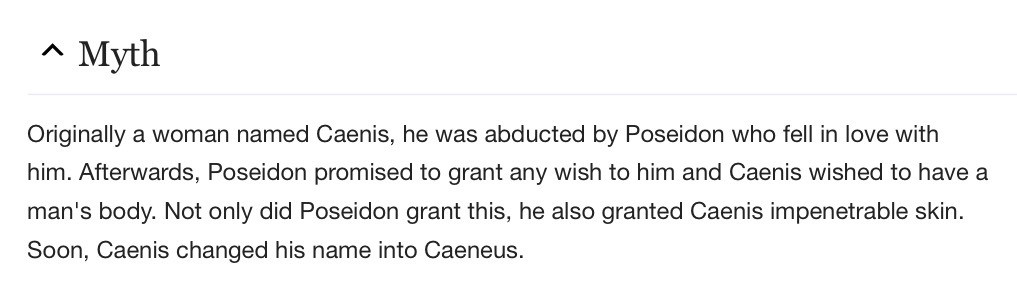
shout out to my fave under-appreciated unbreakable transgender hero
The thing that gets me is he didn’t ASK for the impenetrable skin. Poseidon was just like “cool cool but you know what you need? skin of IRON. don’t worry bud it’s on the house”
i’m just saying hermes is not only a trickster god who likes gambling and risk and traveling and making mischief and laughing and playing music and kickin’ it but he’s also the guide of the souls in the underworld and one that is metal af and two it is quite a magnificent show of character
like here let’s play while you’re racing and daring and alive and then when you’re not let me take your soul home




 ImagineCreateDevour