a concept: Harry Potter with his mother’s hair and father’s eyes instead of vice versa.
Harry with fiery dark red hair and soft hazel eyes please and thank you
i imagine this is how harry and draco’s first meeting would have gone then haha
can you imagine how much more confused arthur would have been in that scene where he first meets harry 😂
his eyes would probably sweep right over harry at the breakfast table, and then he would freeze and have to do a mental tally of his children
I can see Fred and George really going with it too…
“Come on Dad, don’t you remember Harry?” “Next you’ll tell us you don’t remember Craig” “Or Ethel” “Or Annie“ “Or Ryan”
I really want this to be a thing
Okay but like…every professor at Hogwarts would have to do the exact same mental math as Arthur, and then realize that he’s Harry freakin’ Potter, and redo their math AGAIN.
Arthur sits down at the table. As he picks up a piece of toast, his eyes sweep the table, ready to greet his family.
“Good morning childr-”.
He stops when he spots a young boy with fiery red hair and fringe. The child is also wearing old clothes that once belonged to Charlie and round glasses on his face. Arthur sees his family looking at each other at the confusion this brings him. Molly speaks up.
“Harry, would you care for more eggs”?
“Yes, please. Thank you”.
Arthur breathes a sigh of relief. No child of his would be so polite. He didn’t forget anyone…this time.
Molly was very much running late and there was nothing she could do about it. Not only was she running late, but she was running late to get all of her children on the train to Hogwarts. When she saw one of them running behind, she simply sighed. “Dear, you’ve got to keep up!”
Fred was laughing for some reason but just ran through the gateway to the platform.
George followed suit, getting only a few words out between his chuckling. “Count heads mum! It seems we picked up a stray!”
As Ron went through, Molly turned around to count how many kids were left. Two. The twins had gone, Ginny was there, he wasn’t Percy and Ron just went. “Oh I’m sorry, I thought you were one of mine! I have seven and it’s hard to keep track!”
“That’s alright miss, I needed to get on the platform anyway. Can you show me how?” Years later, she would it would be said that she had counted her children correctly.
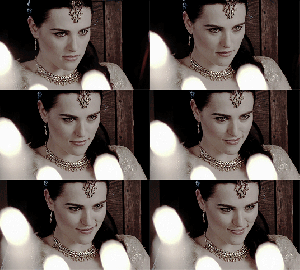
“I have no doubt that at some point they will give a remake a go, and it’ll break my heart to see somebody else play Morgana. She was so wonderful for me, I couldn’t deny that gift to somebody else. She’s been amazing – she still is, I still use her in other performances. I still find myself doing ‘smirkana’ every so often. Nope – probably shouldn’t do that!” – Katie McGrath.
We have a lot of sources from Ancient Egypt, especially the Old Kingdom (~2700-2200), that mention dwarves, their titles, their ranks, and their official functions in AE society.
The AE word for dwarf/pygmy/little person is “dng”, possibly pronounced “Deneg” or ”Daneg”. Alternatively, the word could also be written as “dAg”. Usually, as a Determinative, the sign A282 is used:
Furthermore, there was a differenciation between what people tend to call “Pygmies” – which were usually brought* to Egypt for dance shows and celebrations (dngjbA,w), and Egyptian born dwarves. *These were highly requested artists, who were paid well and enjoyed high status.
During the Old Kingdom, dwarves were highly respected, and even thought to be magical, or blessed by the gods. The first signs of possible ableism and discrimination because of their stature crop up in New Kingdom wisdom texts* (texts that describe how to be a wise and well mannered person), where one would be admonished to not treat dwarves and people with disabilities badly. *one example would be
papyrus B.M. 10474
The fact that dwarvism doesn’t appear at all in AE medicinal texts, makes it probable that AE doctors knew dwarvism wasn’t an illness that needed to be cured.
The most famous artistic depiction of a dwarf is the Old Kingdom statue of Seneb and his family, found in his tomb. He was married to a member of the aristocracy, he fathered “normal” sons and enjoyed high rank in the royal court. His many titles reveal that he performed ritual duties as a priest and was denoted “Beloved of the King,” in addition to enjoying prestigious occupations such as control over weaving activities in the palace, control of the seal (a byword for royal trust) and charge of ritual boats.
Another dwarf, this time a so called “Pygmy”, that would be imported* from Punt, is mentioned in a letter, written by the young king Pepi II.
2284–2184 BC. The king expresses his excitement about getting to see the dwarf, and also concecrn about his safety and well-being. (Letter to Herchuf from Pepi II. – there are multiple good translations out there, personally I prefer the TLA one, but not everyone understands German.) *maybe imported is the wrong word, it would have been a great honor for the dwarf, to get to dance for the king of Egypt, and he would have been richly rewarded!
A third, very interesting depiction of a dwarf comes from the time of
King Nectanebo II, the last ruler of the 30th dynasty (he reigned between 360–343 BCE, so in the Late Period). The naked figure of the dwarf Djeho, at life-size, measuring 120 cm, is carved on the lid of his sarcophagus, which is made out of granite and is of superb workmanship.
Recommended reading:
Hans-Werner Fischer-Elfert: „Lache nicht über einen Blinden und verspotte nicht einen Zwerg!“ Über den Umgang mit Behinderten im Alten Ägypten. In: Max Liedtke (Hrsg.): Behinderung als pädagogische und politische Herausforderung. Historische und systematische Aspekte. 1996, S. 93–116.
C. Kozma: Dwarfs in Ancient Egypt. Hoboken NJ 2006.
V. Dasen: Dwarfs in Ancient Egypt and Greece. Oxford u. a. 2013















 ImagineCreateDevour