
With permission from lettherebedoodlesI decided to take their amazing Racebent Disney Princess Series and, rather than just seeing them as different versions of the original characters, give them stories and fairy tales of their own. I plan on doing their entire series- hopefully I won’t disappoint!
Some of the stories will be based on the culture the new heroine is based on, and others will be stories from other cultures (such as ‘traditional’ western fairy tales), even real life people will inspire theseDisney-style Princesses and Heroines. But please remember-this is all for fun. I’m not pretending to be an expert on any of this. I’ll try my best to do right by these characters and cultures, and if there is something horribly offensive, please let me knowhow I can fix it.
Sorry I’m a crappy graphic designer, btw.
Sarika- Seven Wild Cranes
Based on the Hans Christian Anderson fairy tale The Wild Swans. Sarika and her seven older brothers are royalty. Their mother had died, and so their father took a second wife, who was a very jealous woman who hated the children. She uses magic to try to turn the children into cranes and send them far away, but her magic didn’t work on Sarika, only the brothers. The evil stepmother decides to just kill Sarika and blame the missing brothers, but the children are able to escape.
Sarika and her crane brothers search for a way to reverse the curse, but find out the solution is much more complicated than they hoped. In the end, Sarika may have to decide between saving her brothers and making an ultimate sacrifice.
Important Note: This is actually another fairy tale of Anderson’s where a heroine looses the use of her voice. That fact, plus my huge love of the gorgeous Demoiselle Crane, or Koonj (which is native to India and features prominently in much of their story telling) are why I decided to give this European fairytale an Indian twist.
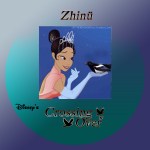
Zhinü- Crossing Over
Based on the famous Chinese legend of The Weaver Girl and the Cowherd, which is celebrated every year during the Qixi (or Qiqao) Festival.
Sorry about the shitty photoshop magpie over the frog.Zhinü was one of many daughters of the Goddess of Heaven. She was playful and smart, and helped weave colors into the sky. One day she became bored and decided to explore the human world. There, she met a mortal man named Niulang, who herded cows for a living. Niulang was hard working and serious and never did anything for fun- and this fascinated Zhinü, since in the heavens everyone was very relaxed. But they grew close, as Zhinü brought color and magic and Niujlang showed her how steadiness and stability can be important too. Soon they fell in love.
But love between humans and immortals was forbidden, and if one spend too much time in the world of the other, the universe would start falling out of balance and falling apart. Zhinü is forced to return to heaven, and she and Niulang try to find a way to be together without tearing the world apart.
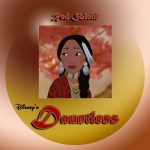
Red Shield- Dauntless
Inspired by the folk tale of Red Shield and Running Wolf, a frequently retold story by various Plains Indian tribes of North America.
Red Shield was raised on stories of the brave warriors of her tribe and their fights against the neighboring nations. She dreamed of fighting in epic battles and hunting buffalo, but her job was to take care of the people in her village. One day, while the warriors and hunters were all gone, a neighboring tribe attempted to raid and steal all of their horses. Red Shield road out to stop them by herself, impressing the enemy leader, Running Wolf.
Both of them are incredibly stubborn and strong-willed.. Soon, the two of them find themselves butting heads in other situations. They fight like a brother and sister, and even begin to feel like they are siblings. But through their combined stubbornness, they find a way to stop the long-standing war between their two nations.
Important note: I have very little knowledge of Native American culture. In the version I found, Red Shield was Lakota/Sioux, and Running Wolf was Crow- but since I don’t know enough about Plains Indian politics, I refrained from naming either nation. Also, in the original legend, the two fall in love and are married. Personally, I’d like to see some more brother-sister bonds instead.
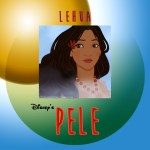
Lehua- Pele
Based on the Hawaiian legend of Pele’s Revenge. Lehua was a gentle, fragile young woman who lived on Hawai’i. She was shy, and soft-spoken, but fell in love with the town hero- Ohi’a. He was the best at everything, extremely popular with the ladies, handsome… but once he met Lehua, they became inseparable, deeply in love.
Unfortunately, one of the people who also fell for Ohi’a was the goddess of volcanos, Pele. Pele was incredibly powerful and passionate, but prone to jealous and rage. When Ohi’a refused her hand in marriage for Lehua, Pele captures him, and threatens everyone with lava and destruction. It’s up to shy, gentle Lehua to find a way to save her love and the entire island.
P.S. If anyone has any sources on African (specifically Luo/West Niletic- think the Jasmine edit) stories, folktales, even modern fiction, please let me know. I’m having a lot of trouble with it.
No, but you don’t understand how Lehua would be perf. It really nice to have that written out. There are at least two legends that I know of where Pele’s going after a dude and doesn’t get him. Anyway, I just got really excited, being Native Hawaiian I don’t often see my culture recognized in a non-superficial way.
Okay. That comment. OMG. I can’t even. That just makes me so incredibly super happy. Native Hawaiian culture (and language) is one of my favorite things to learn about, and to hear that I did even a little bit of justice to it just made my entire month.
Doing this little project, I was really concerned that I might not do right by the cultures I’ve been representing in these stories, so reactions like this are just amazing.

 ImagineCreateDevour